- by Prof. Christian Gnoth
What exactly are HLA-C and KIR?
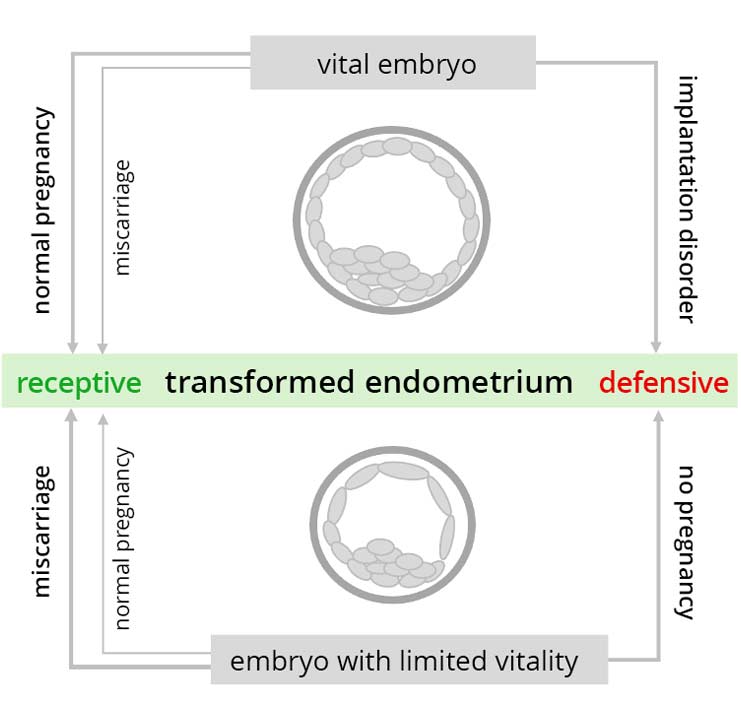
For a pregnancy to occur, the semi-foreign embryo (genetically and immunologically half father, half mother) must implant in the uterus. This process is controlled not only by hormones but also by the mother’s immune system.
Two important factors play a role:
- HLA-C: A characteristic on the cells of the embryo that is inherited from the mother and father. Important: Each embryo has its own unique combination, even if the parents remain the same.
- KIR receptors: Recognition features on certain immune cells in the uterine lining (so-called uNK cells = “uterine natural killer cells”). They are the embryo’s “bodyguards.”
If the HLA-C signature of the embryo and the KIR status of the mother match, the embryo can implant better.
Why do embryos from the same parents differ?
Even if the mother and father remain the same, each child inherits a different mix of their genes. This means:
- An embryo can have a harmonious combination of HLA-C and maternal KIR.
- The next embryo may have a less favorable combination.
If a cycle does not result in pregnancy, it is usually due to genetic factors (meiosis and mitosis errors). However, it can also happen that for the immunological reasons mentioned above, some cycles (even with artificial insemination) do not lead to pregnancy. This is not because “something is fundamentally wrong” – but because of the random combination of genes, which varies with each embryo.
Which combinations are considered less favorable?
In rare cases, there is a stronger inhibition of implantation.
This primarily affects women with a specific KIR type (“KIR-AA”) without (always the case, as genetically determined) activating killer cell receptors, who carry embryos that have inherited a specific HLA-C type from the father (“C1”, not always, varies from embryo to embryo). This combination can cause the uterine lining to prevent or hinder implantation and then inhibit placental development too much, which can lead to miscarriages or pregnancy complications (so-called gestoses) during pregnancy.
Importantly, this combination is not an absolute exclusion for a pregnancy – many women with this combination become pregnant without any complications, as many other factors play a role in how well an embryo implants (embryo viability).
Determining the KIR genes can be useful in the following cases:
- Repeated early miscarriages
- Lack of implantation despite good embryos (IVF/ICSI)
- Evidence of placentation problems in previous pregnancies
KIR typing (blood test) is more important than HLA-C typing.
In the situations mentioned above, understanding the immunological constellations helps to narrow down possible causes and adjust further treatment accordingly, e.g., by administering special medications containing growth factors that are insufficiently produced by the killer cells when activation is inadequate (G-CSF). Treatment can also be optimized by
- Adjusted hormonal support of the cycle, here progesterone is particularly important, which is a natural activator of uterine killer cells
- Anti-inflammatory or immunomodulatory therapies in selected cases
- Precise selection of the suitable embryo for an embryo transfer during IVF
- Close monitoring of early pregnancy
It is important to note that it is not about suppressing the immune system, but about restoring its balance.